Address
304 North Cardinal St.
Dorchester Center, MA 02124
Work Hours
Monday to Friday: 7AM - 7PM
Weekend: 10AM - 5PM
Address
304 North Cardinal St.
Dorchester Center, MA 02124
Work Hours
Monday to Friday: 7AM - 7PM
Weekend: 10AM - 5PM
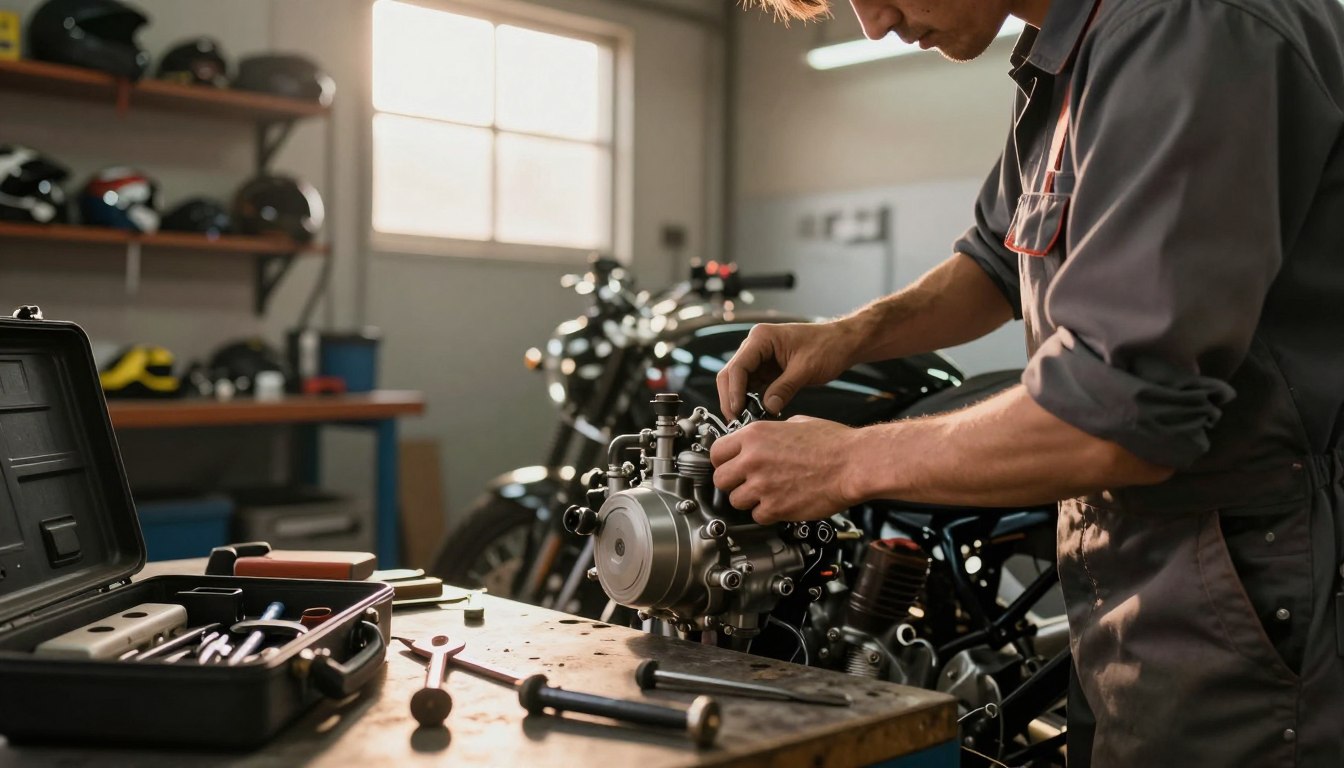
Waking up for an early ride feels great until your bike refuses to turn over. You gear up, hit the starter, and hear nothing but a weak click. These morning starting issues can ruin your schedule and leave you frustrated in your own driveway.
When the temperature drops, cold weather starting problems become much more frequent for riders across the country. Thick oil and a chilled battery often make it difficult for the engine to fire up. Most of these hiccups are easy to solve with simple motorcycle troubleshooting techniques.
Emphasizing the need for a quick check on your battery and fuel lines can save you plenty of stress. Learning these quick tricks ensures you stay on the road regardless of the morning chill. Let’s explore how to get your engine roaring once more.
The inability to start a motorcycle in the morning can stem from various issues, ranging from simple to complex problems. Understanding these issues is the first step towards resolving them.
Several factors can contribute to a motorcycle’s failure to start in the morning. These include:
These issues can be due to various reasons such as age, wear and tear, or maintenance neglect.
Temperature plays a significant role in motorcycle starting problems. Cold temperatures can cause the engine oil to thicken, making it harder for the engine to turn over. Additionally, cold temperatures can affect the battery’s performance, reducing its ability to hold a charge and provide the necessary power to start the motorcycle.
| Temperature Effects | Description |
|---|---|
| Engine Oil Thickening | Cold temperatures cause engine oil to thicken, making engine startup harder. |
| Battery Performance | Cold weather reduces battery efficiency and its ability to start the motorcycle. |
| Fuel System | Cold temperatures can cause fuel to evaporate less readily, affecting engine start-up. |
To fix the issue, it’s crucial to identify the root cause. This involves checking the battery voltage, inspecting the spark plugs, examining the fuel system, and ensuring the ignition system is functioning correctly. A systematic approach helps in diagnosing the problem accurately.
By understanding the common issues and how temperature affects your motorcycle, you can take the first steps towards resolving morning starting problems.
When your motorcycle refuses to start in the morning, one of the first components to inspect is the battery. A well-maintained battery is crucial for a smooth start.
A weak battery can manifest in several ways. Look out for these common signs:
If your motorcycle’s headlights are dimmer than usual or the horn sounds weak, it could be a sign that your battery is losing its power.
When you turn the key, if the engine cranks slowly or makes a sluggish turning sound, it indicates a battery that’s struggling to provide enough voltage.
To determine if your battery is holding a charge, you’ll need to test its voltage.
A multimeter is a handy tool for measuring the voltage of your motorcycle battery. Set the multimeter to DC volts and touch the leads to the battery terminals.
A fully charged battery should read around 12.6 volts. If the reading is significantly lower, it may indicate a discharged or weak battery.
| Voltage Reading | Battery Condition |
|---|---|
| 12.6V or higher | Fully charged |
| 12.4V – 12.5V | Partially discharged |
| Below 12.4V | Discharged or weak |
Corrosion on the battery terminals can prevent your motorcycle from starting. Cleaning the terminals can resolve this issue.
Use a wire brush and a mixture of baking soda and water to clean the terminals. Make sure to wear protective gloves and eyewear.
After cleaning, apply a thin layer of petroleum jelly or terminal protection spray to prevent future corrosion.
If your battery is dead, jump-starting can get you back on the road. Ensure you follow the correct procedure to avoid damaging your motorcycle’s electrical system.
By following these steps, you can diagnose and potentially fix issues related to your motorcycle battery, getting you back to riding in no time.
When your motorcycle refuses to start, one crucial system to inspect is the fuel system. A well-functioning fuel system is essential for delivering the right amount of fuel to the engine. Issues within this system can lead to starting problems, especially after a period of inactivity.
The first step in inspecting the fuel system is to check the fuel level and quality. Ensure that there is sufficient fuel in the tank. Sometimes, the fuel level might be lower than expected, or the fuel might have degraded over time.
Stale gasoline can cause significant issues, including difficulty starting the engine. Gasoline can degrade over time, losing its volatility and potentially causing varnish buildup in the fuel system. To test for stale gasoline, check its color and consistency. Fresh gasoline is typically light in color and free of sediment.
If the gasoline appears dark or has a varnish-like consistency, it’s likely stale and should be drained. Draining old fuel and replacing it with fresh gasoline can resolve starting issues related to fuel quality. Ensure you dispose of the old fuel properly and refill with the correct type of gasoline for your motorcycle.
The fuel petcock is responsible for controlling the flow of fuel from the tank to the engine. Inspect the petcock for any signs of damage or wear. Ensure it is functioning correctly and not restricting fuel flow.
Fuel lines can become clogged or damaged, preventing fuel from reaching the engine. Inspect the fuel lines for any blockages, cracks, or signs of wear. Replace any damaged fuel lines to ensure proper fuel flow.
Clogged fuel filters can also prevent the engine from receiving the fuel it needs to start. Check the fuel filters for any signs of clogging or debris. Cleaning or replacing clogged fuel filters can help resolve starting issues related to the fuel system.
A crucial step in diagnosing why your motorcycle won’t start in the morning involves examining the spark plugs. Spark plugs are essential for the proper functioning of your motorcycle’s engine, as they ignite the fuel-air mixture that powers the engine.
Faulty or worn-out spark plugs can lead to starting issues, among other problems. Therefore, it’s vital to know how to inspect, clean, and replace them as needed.
The first step in examining your spark plugs is to remove them. This process requires care to avoid damaging the spark plug or its thread in the engine.
To remove a spark plug, you’ll need a spark plug socket that fits your motorcycle’s spark plug. Ensure the engine is cool, then remove the spark plug wire by pulling it straight off. Use the spark plug socket to loosen and remove the spark plug.
Tip: Be gentle to avoid stripping the threads.
Once removed, inspect the spark plug for signs of wear or fouling. A healthy spark plug should have a light tan or gray color on the insulator tip.
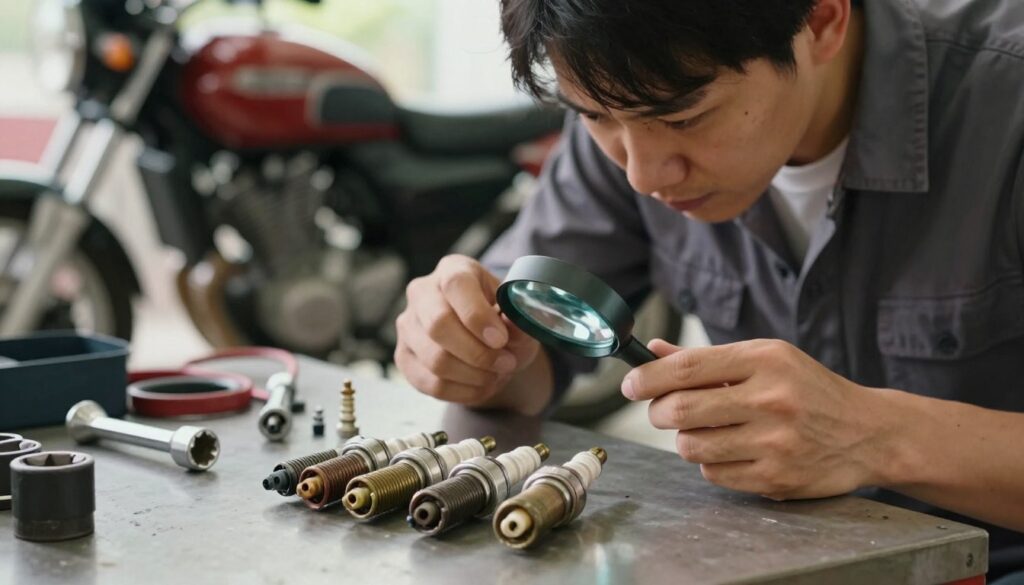
Common issues include:
Depending on the condition of your spark plugs, you may be able to clean them or need to replace them.
For spark plugs with minor fouling, a wire brush can be used to clean the electrodes. Gently brush away any deposits, taking care not to damage the electrodes.
“Regular maintenance of spark plugs can significantly improve your motorcycle’s performance and fuel efficiency.”
If your spark plugs are worn out or heavily fouled, replacement is necessary. Consult your motorcycle’s manual to find the correct type and gap specification for your spark plugs.
| Spark Plug Type | Characteristics | Best For |
|---|---|---|
| Copper | Good conductor, cheap | Older motorcycles or those with less demanding engines |
| Platinum | Longer lifespan, better performance | Modern motorcycles or those requiring high-performance spark plugs |
| Iridium | Excellent conductivity, long lifespan | High-performance motorcycles or those with turbochargers |
The spark plug gap is critical for proper engine performance. Use a spark plug gap gauge to check the gap against the manufacturer’s specifications.
Adjusting the gap: If necessary, adjust the gap by carefully bending the ground electrode. Ensure the gap is within the recommended specification to avoid engine misfires or poor performance.
Troubleshooting your motorcycle’s carburetor is crucial when facing starting issues on cold mornings. The carburetor plays a vital role in mixing air and fuel for the engine, and its performance can be significantly affected by cold temperatures.
In cold conditions, the carburetor has to work harder to provide the correct air-fuel mixture. Cold air is denser, which means it contains more oxygen per unit volume than warm air. This requires the carburetor to adjust the amount of fuel it mixes with the air to maintain an optimal air-fuel ratio.
Cold temperatures can cause the fuel to evaporate less readily, making it harder for the engine to start. Understanding this helps in diagnosing issues related to the carburetor.
Cleaning the carburetor jets is a critical step in troubleshooting carburetor issues. Dirt or debris in the jets can disrupt the air-fuel mixture, causing starting problems.
To clean the carburetor jets effectively, you may need to remove the carburetor from your motorcycle. This process involves disconnecting the fuel line, throttle cable, and any other connected components. It’s essential to consult your motorcycle’s manual for specific instructions.
Once removed, you can use a carburetor cleaner to spray into the jets and other passages. This helps dissolve any varnish or debris that might be obstructing the flow of fuel.
After cleaning, reassemble the carburetor in the reverse order of how it was disassembled. Ensure all connections are secure and not leaking.
The air-fuel mixture is critical for the proper functioning of your motorcycle’s engine. Adjusting this mixture can help resolve starting issues.
To adjust the air-fuel mixture, locate the mixture screws on your carburetor. Turning these screws clockwise typically richens the mixture (more fuel), while turning them counterclockwise leans the mixture (more air).
| Adjustment | Effect |
|---|---|
| Clockwise | Richens the mixture (more fuel) |
| Counterclockwise | Leans the mixture (more air) |
Verifying the choke system is an essential step in diagnosing why your motorcycle won’t start in the morning. The choke system is critical for providing the rich fuel mixture needed to start a cold engine.
Using the choke correctly is vital for starting your motorcycle. The choke enriches the air-fuel mixture, making it easier to start the engine when it’s cold.
For motorcycles with a manual choke, ensure that you engage the choke fully when starting the bike cold. Gradually disengage it as the engine warms up to avoid fouling the spark plugs.
Automatic choke systems simplify the process by adjusting the air-fuel mixture automatically based on engine temperature. However, if your motorcycle is having trouble starting, it might be worth checking if the automatic choke is functioning correctly.
A faulty or stuck choke cable can prevent the choke from operating correctly. Inspect the choke cable for any signs of damage or wear, and ensure that it moves freely.
Several issues can arise with the choke system that might prevent your motorcycle from starting.
A stuck choke valve can either prevent the engine from getting enough fuel to start or cause it to run too rich, leading to starting issues. Cleaning or replacing the choke valve may be necessary.
A broken choke cable will render the choke inoperable. Inspecting the cable regularly can help identify potential issues before they cause starting problems.
| Choke System Issue | Symptoms | Solution |
|---|---|---|
| Stuck Choke Valve | Engine won’t start or runs poorly | Clean or replace the choke valve |
| Broken Choke Cable | Choke won’t engage or disengage | Replace the choke cable |
To diagnose why your motorcycle isn’t starting, checking the electrical connections is a fundamental step. Electrical issues can often be the culprit behind a motorcycle that refuses to start, especially in the morning.
The ignition switch and kill switch are critical components of your motorcycle’s electrical system. A faulty switch can prevent your motorcycle from starting.
To test the continuity of these switches, use a multimeter. Set the multimeter to the ohms function and touch the probes to the switch terminals. A low resistance reading indicates good continuity.
Corrosion on wiring can disrupt the electrical flow, preventing your motorcycle from starting. Inspect the wiring for any signs of corrosion or damage.
Look for connectors with green or white buildup, as these are signs of corrosion. Cleaning or replacing these connectors can resolve starting issues.
Use a contact cleaner or a mixture of baking soda and water to clean corroded contacts. Ensure the contacts are dry before reconnecting.
The ignition coil is responsible for generating the spark that ignites the fuel. A faulty ignition coil can prevent your motorcycle from starting.
Use a multimeter to measure the primary and secondary resistance of the ignition coil. Compare your readings to the manufacturer’s specifications to determine if the coil is functioning correctly.
By thoroughly testing your motorcycle’s electrical connections, you can identify and fix issues that may be preventing it from starting in the morning.
Starting your motorcycle in the morning can be a challenge, but with the right approach, you can overcome the difficulties. This section provides a comprehensive guide to help you tackle morning starting issues effectively.
To start your motorcycle successfully in the morning, follow a systematic approach. Begin with a pre-start checklist to ensure all critical components are in good condition.
Once you’ve completed the pre-start checklist, follow the proper starting sequence:
If your motorcycle still refuses to start, check for any obvious issues such as a dead battery or empty fuel tank. If these basic checks don’t reveal the problem, it may be necessary to inspect other components like the spark plugs or fuel system.
Sometimes, a quick fix is all you need to get your motorcycle running. Here are a few techniques to try:
Bump starting can be an effective way to get your motorcycle started if the battery is weak. To bump start, put the motorcycle in second gear, switch the ignition on, and push the motorcycle to gain some speed. Then, release the clutch suddenly to engage the engine.
Starting fluid can help if your motorcycle is having trouble starting due to a rich or lean fuel mixture. Spray a small amount into the air intake, then try to start the engine. Be cautious not to overuse starting fluid, as it can cause damage.

For persistent starting issues, consider implementing long-term solutions. Regular maintenance is key to preventing morning starting problems. This includes checking and maintaining the battery, spark plugs, and fuel system regularly.
Motorcycle starting problems in cold weather are a common issue that can be addressed with the right knowledge and preparation. Cold temperatures can affect various components of your motorcycle, making it essential to understand the causes and implement appropriate solutions.
The viscosity of your motorcycle’s oil plays a crucial role in its performance during cold weather. Thicker oil can make it harder for your engine to turn over, potentially leading to starting issues.
Selecting the appropriate oil weight for your motorcycle is vital. A lighter oil weight can improve starting in cold conditions. For example, switching from a 10W-40 to a 5W-30 can make a significant difference.
Synthetic oil generally performs better in cold temperatures than conventional oil, offering easier starts and better engine protection. Consider making the switch if you live in an area with harsh winters.
| Oil Type | Cold Weather Performance | Engine Protection |
|---|---|---|
| Conventional Oil | Fair | Good |
| Synthetic Oil | Excellent | Excellent |
Engine heaters can be a valuable investment for riders who frequently face cold-weather starting issues. These devices help maintain a warmer engine temperature, making it easier to start your motorcycle.
Installing a block heater can be an effective solution. It works by warming the engine block, thus improving starting conditions in cold weather.
A Battery Tender is another useful tool. It keeps your battery charged and healthy, ensuring that you have enough power to start your motorcycle even on the coldest mornings.
After starting your motorcycle in cold weather, it’s essential to let it warm up properly. Avoid revving the engine immediately; instead, let it idle for a few minutes to allow the oil to circulate and warm up.
By understanding the impact of cold weather on your motorcycle and implementing these strategies, you can significantly improve your bike’s starting performance during the winter months.
When your motorcycle won’t start, one of the key areas to investigate is the starter motor. A malfunctioning starter motor can leave you stranded, especially on chilly mornings when your bike is more reluctant to start.
Identifying the symptoms of a failing starter motor is the first step in diagnosing the issue. Common signs include:
A clicking sound when you press the start button, but the engine doesn’t crank, often suggests that the starter motor is not functioning correctly. This could be due to worn-out brushes or a faulty solenoid.
If there’s complete silence, it might indicate a more severe issue, such as a dead battery, faulty wiring, or a completely failed starter motor. It’s essential to check the battery voltage and wiring before concluding the starter motor is at fault.
To diagnose starter motor issues, you need to perform some tests. Here are the steps:
A direct power test involves connecting the starter motor directly to a battery to see if it spins. This test can help determine if the starter motor is functional.
“A direct power test is a straightforward way to check if your starter motor is working. If it doesn’t spin when connected directly to a battery, it’s likely faulty.”
Sometimes, the issue isn’t with the starter motor itself but with seized components that prevent it from functioning. Check for any mechanical issues that might be causing the starter motor to fail.
The starter relay plays a crucial role in the starting circuit. A faulty relay can prevent the starter motor from receiving power. Check the relay for any signs of damage or malfunction.
“The starter relay is often overlooked but is a critical component in the starting system. Ensuring it’s functioning correctly is vital.”
Preventive maintenance is key to avoiding the frustration of a motorcycle that won’t start in the morning. By adopting a proactive approach to maintaining your vehicle, you can significantly reduce the likelihood of starting issues.
Your motorcycle’s battery is a critical component that requires regular checks to ensure it remains in good condition. Neglecting battery maintenance can lead to starting problems, especially after periods of inactivity.
Performing monthly checks on your battery involves inspecting the terminals for corrosion, checking the electrolyte levels (if applicable), and ensuring the battery is properly secured. Cleaning the terminals with a wire brush and applying a corrosion inhibitor can prevent common issues.
Batteries have a limited lifespan, typically ranging from three to five years. If your battery is nearing or has exceeded this age, or if it fails to hold a charge, it’s time to consider replacing it. Look for signs of wear, such as slow engine crank or dimming lights, as indicators that a replacement is needed.
Different seasons present unique challenges for motorcycles. Preparing your bike for the changing weather conditions can help prevent starting issues.
Before winter sets in, ensure your motorcycle is winter-ready. This includes changing to winter-grade oil, checking the antifreeze, and ensuring the battery is fully charged. Using a battery tender or maintainer can keep your battery healthy during prolonged periods of inactivity.
As winter ends, perform a thorough inspection of your motorcycle. Check the tire pressure, brakes, and fluid levels. It’s also a good time to replace any worn-out parts and give your motorcycle a good clean.
How you store your motorcycle can significantly impact its condition and readiness to start. Proper storage techniques can help maintain your bike’s overall health.
Whenever possible, store your motorcycle indoors to protect it from the elements. If indoor storage isn’t an option, use a high-quality motorcycle cover to shield it from rain, sun, and dust. Outdoor storage requires additional precautions, such as using a dehumidifier to prevent moisture buildup.
A good motorcycle cover not only protects your bike from environmental factors but also helps keep it clean. Look for a cover that is breathable, waterproof, and UV-resistant.
| Storage Method | Benefits | Precautions |
|---|---|---|
| Indoor Storage | Protection from elements, reduced risk of theft | Ensure good ventilation to prevent moisture buildup |
| Outdoor Storage with Cover | Cost-effective, convenient | Use a high-quality cover, consider using a dehumidifier |
Establishing a regular maintenance schedule is crucial for the longevity and reliability of your motorcycle. By keeping track of when different components were last serviced, you can anticipate and prevent potential issues.
Regular maintenance not only ensures your motorcycle starts reliably but also enhances its overall performance and lifespan. By following these guidelines, you can enjoy a hassle-free riding experience.
Troubleshooting a motorcycle that won’t start in the morning can be a challenging task, but with the right approach, it can be resolved efficiently. By understanding the common issues that cause starting problems, such as battery weakness, fuel system faults, and spark plug wear, you can take corrective action to get your motorcycle running smoothly.
A thorough troubleshooting summary involves checking the battery voltage, inspecting the fuel system, examining spark plugs, and verifying the choke system. Regular maintenance is crucial to prevent morning starting issues. This includes regular battery maintenance, seasonal motorcycle preparation, and proper storage techniques.
By following the steps outlined in this guide and incorporating a routine maintenance schedule, you can minimize the likelihood of your motorcycle failing to start in the morning. Proper care and attention to your motorcycle’s needs will ensure a reliable and smooth start every time.
